Before the technology, what's the real story?
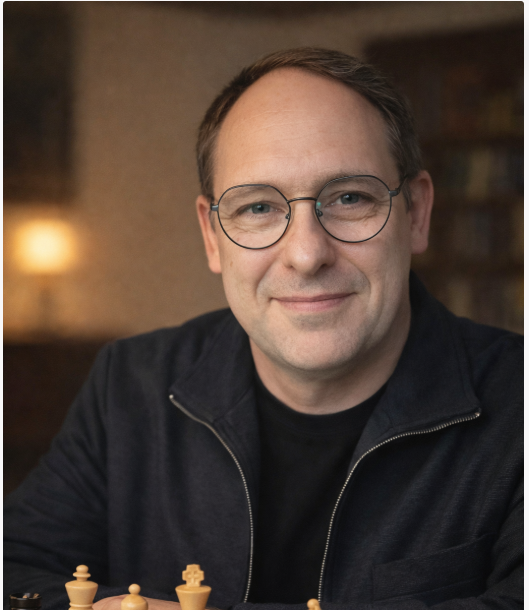
I'm 48. I have twin boys, 14. And like every parent of teenagers today, I watch them disappear for hours into those big game platforms. Everyone knows the ones. I won't name them. But you know exactly what I mean.
What made it sad for me specifically is that when they were small, we were always at the chessboard together. That was our thing. And at some point the chessboard disappeared and the screen took over.
So I decided to build them something. A Christmas gift. A chess game, but one that would feel alive to them. With the help of modern development tools, I started building it as a hobby project. I downloaded my own games from Lichess (I'm a club player, nothing special) and the very first prototype of what would become the ChessGate personality system was built around me. My own games. My own patterns.
And it played like me. That's when the light came on.
It wasn't refined. Rough edges everywhere. But the signal was unmistakable. So I thought: if it works on a hobby player, what happens when I feed it a grandmaster? I found the first game database, built the first grandmaster personality, and it started playing like that person. Not perfectly. But recognizably. Unmistakably. From there it snowballed.
Was there a specific person who pushed you from idea to obsession?
As a collector of chess computers I'd had the opportunity to become friends with Thorsten Czub, a key consultant on ChessSystem Tal, one of the most remarkable chess programs ever written. In the nineties, ChessSystem Tal was famous for playing speculative attacking sacrifices that no pure calculation engine would ever attempt. It had something. A philosophy encoded inside it. You could feel the programmer's hand.
A few years ago I read a piece Thorsten had written in a chess forum, and one line stopped me cold. He asked: when will programmers finally write a chess system again that knows how to plan? That thinks differently than pure brute force?
I thought: well. Let's try.
And I had the enormous luck that Thorsten came on board early, testing the prototype desktop version and coming back with extraordinarily useful feedback. To have someone of that legendary status as a free collaborator on a three-person team, it was a real anchor point for the credibility of the whole project. He knew exactly what we were trying to do, because he'd tried to do something related himself, thirty years earlier.
What makes the Czubatronic 2400 more than a modern chess box?
The Czubatronic 2400 is a tribute to a whole era of computer chess, and at its heart lies Capa, Thorsten Czub's own chess program. The name is a nod to José Raúl Capablanca, whose effortless accuracy fascinated Czub as a young chess player. It was never designed as a brute-force super-engine. It began as a personal laboratory, a way of understanding how a chess machine actually thinks.
Capa grew through several generations of hardware — Sinclair ZX Spectrum, Amstrad CPC 464, Atari ST, then PC — and through several programming environments, from BASIC to PowerBASIC and later FreeBASIC. It absorbed ideas from open chess-programming culture: published sources, engines, ideas, and experiments from the people who were actually building the machines and programs that shaped the era.
That history matters. There are stronger engines in 2026, but the point of the Czubatronic 2400 is not to out-muscle everything else. It is to rebuild the feeling of a dedicated chess computer: a machine with a recognisable origin, a personality, and a history. Capa has commentary, twelve levels, permanent-brain play, position setup, and that original dedicated-computer character still intact. It is an old project brought back to life without pretending the decades in between never happened.
Why bring Capa back now, after decades of silence?
In 2026, the project resumed with the old PowerBASIC DOS version migrated to FreeBASIC for Windows. From there it gained a modern engine infrastructure: hash tables, opening books, UCI support, draw detection, tournament time controls, move ordering, MVV-LVA, history heuristics, null-move pruning, and improved tactical search. The intention was not to erase the old Capa, but to preserve its character while giving it the tools of a modern engine.
That is why it fits the Czubatronic 2400 so well. It is not simply a modern UCI engine dropped into a retro shell. It retains the original menu, the original levels, the commentary, the permanent-brain behavior, and the rough edges that make it feel like a machine with a soul. In other words, it still behaves like a dedicated chess computer rather than a generic engine wrapper.
When will programmers finally write a chess system that knows how to plan? I read that and thought — well. Let's try.
— Arne BailliereYou have a Tal personality. But Tal is almost a caricature at this point.
Exactly, and that's the challenge. Everyone remembers Tal from 1957 to 1961: world champion, speculative sacrifices, go crazy, throw everything at the king. That's the legend.
But the real Mikhail Tal, the one who played serious tournament chess across decades, also developed an exceptionally strong positional style. He had to. You cannot survive at the top level for thirty years on brilliance alone. The real Tal was a beast positionally when the position called for it.
Because we build our personalities from the entire career database, not a curated selection of famous attacking games, our version of Tal reflects who he actually was. He can sacrifice. He will sacrifice, when the plans support it. But he can also grind positionally, tighten a structure, outmaneuver. He is not a caricature. He is a representation of a complete chess mind.
That distinction between the legend and the real player is something we care deeply about across all the personalities. The data decides. Not the myth.
Everyone says they offer personality. What's actually different here?
The process starts long before anyone plays a game. Each ChessGate personality is built through a 13-stage analysis pipeline that runs for several hours using multiple engines simultaneously. We extract opening books from the player's real games, mine positional and tactical patterns, discover multi-move strategic plans through backwards analysis, and build causal chain models — understanding why a player made the choices they made, not just what they played. We compute decision formulas: under what conditions does this player deviate from engine recommendations? What does he do differently in open positions versus closed ones? How does his style shift between the middlegame and the endgame? What positional structures does he seek, and which does he avoid?
This is computationally expensive — once. It uses our proprietary extraction formulas across several engines to define deviation patterns and style rules depending on game phases and position structure. But once that deep analysis is complete, the knowledge is available cheaply during gameplay. The engine generates candidate moves at every position, and the personality layer consults thousands of pre-computed plans, decision formulas, and style rules to select the move that best matches that player's documented preferences. These are lookup operations, not forward search calculations. They cost essentially nothing at game time.
So a club player can actually compete against these legends at their own level?
That's exactly the point. Because the strategic knowledge lives in a separate layer from the tactical calculation, we can adjust playing strength by reducing search depth — two, three, four ply — without touching the personality. The plan library, the decision formulas, the style rules — those are lookup operations. They run exactly the same at two ply as at twenty.
When a conventional system tries to play weaker, it has to inject random errors. Blunders, material giveaways. And you always feel it. There's a moment where the illusion breaks completely. A human would never play like that, let alone Morphy or Tal. We never inject errors. We simply calculate less far ahead. But the strategic mind is still fully intact.
What this opens up is something quite beautiful: you can play against Morphy at your level. A 1,500 ELO player gets a Morphy who won't see deep tactical combinations — but who will still open with rapid piece development, seize open lines, and launch attacks the moment he senses weakness. You are competing against his style, his instincts, his plans. And when you beat him, it's because you genuinely found the refutation of the plan he was executing. You had to work for it. That is a completely different sensation from exploiting a random blunder that no real human would ever make.
There's also something we're still calibrating: the plan layer offers compressed strategic knowledge — a sense of what kinds of positions are good in the long run, extracted from thousands of master games — that a pure engine at the same depth cannot access. In benchmark tests the system with the plan layer active plays consistently stronger at lower depths than the engine alone. The compensation is real, and we're still measuring exactly what it means.
You can play a young Smyslov. A Smyslov at 1,700 ELO, as if he were still a teenager. He won't have the full tactical reach of his prime years. But he will already be playing in his style, reaching for his structures, his plans. That is something no parameter-tweaked engine can ever give you.
You built your own chess engine from scratch. Why go that far?
In the beginning I worked with one of the big established engines, the one everyone uses. And it worked. The personality layer ran on top of it correctly, the plans extracted properly, the whole approach validated. But I kept thinking: at some point someone is going to look at this and say "it's just that engine with a wrapper around it." And they wouldn't be entirely wrong. The credibility of the whole project depended on being genuinely independent.
So I built our own. In C. No neural networks, no NNUE. Classical alpha-beta search, solid tactical calculation, no hard-coded stylistic preferences. That last part was deliberate: the engine's job is simply to provide a sound, unbiased list of candidate moves. The intelligence about how a specific human thinks lives in the layer above it. The engine is a subprocess.
We called it the Ultimate Engine. Not arrogance, just the feeling of having finally built the thing myself, end to end. The compiled binary is 174 kilobytes. It targets around 2,000–2,450 ELO on its own. With the plan layer running at full strength it reaches considerably higher, sometimes well past 2,600. That gap between the engine alone and the engine with the personality layer is itself a measure of what the system contributes.
Early on we'd had to add ELO compensation because the style layer was costing strength because it was overriding tactically stronger moves. But as the causal chain analysis and backwards plan extraction were added layer by layer, something unexpected happened. The cards flipped. The system started playing stronger than intended. We removed the compensation entirely and had to start calibrating from scratch.
And yes, it means nobody can dismiss ChessGate as a skin on someone else's work. That matters to me.
174 kilobytes. No neural networks. Our own engine, because the credibility of the whole project depended on being genuinely independent.
— Arne BailliereThere's a bigger argument here about where chess AI has gone.
Every new engine release is chasing 3,700 ELO. Bigger neural networks, more energy, more data centers, billions of variations in the forward search. I find it fascinating as an engineering achievement. Genuinely.
But the educational value for a human player is zero. We are spectators of something we cannot grasp, cannot replicate, and cannot understand. A 3,000 ELO program will not receive a better suggestion from any human alive. We are completely outside it. That is the case for 99.9% of the players on this planet.
There are enormous numbers of possibilities in a chess game. But they all end the same: checkmate, stalemate, or resignation. The interesting question was never which of the billions of paths gets there fastest. It was: what were the plans, the decisions, the conditions that made certain outcomes possible?
That's what the backwards extraction gives us. We start from the advantageous outcomes and trace back through the causal chains to the plans and decisions that created them. A library built from thousands of master games. Instead of burning energy on a forward search no human can follow, we have compressed strategic knowledge that guides play coherently at any depth, and that a human can actually learn from, analyze against, and feel.
It also makes ChessGate the ideal training partner for club players. The system always plays with intent. It always has a plan. You are always in it. You always have a chance to understand what is going on, and to measure your own strategies against strategies calibrated to your level. That is a wholly different experience than watching a 3,700 ELO engine do something you will never be able to understand or replicate.
My audience is not the engine benchmarking community. It's everyone else.
A 3,700 ELO engine has zero educational value for a human. We are spectators of something we cannot grasp. I'm building for everyone else.
— Arne BailliereIt's all free. How, and why? Is that sustainable?
The platform runs on my own workstation, served through a Cloudflare tunnel at essentially zero server cost. The development time, that's years of evenings and weekends, but this started as a Christmas gift, not a startup. Chess history belongs to everyone.
My own project will always be free. But the technology underneath — the pipeline, the plan extraction, the personality engine — that has applications well beyond what I can serve from my own setup. I would welcome the right partnership to bring this to a wider audience. The methodology scales. The data is there. What's needed is reach, infrastructure, and a shared belief that chess software can be more than just a stronger engine. I think the right collaboration could turn this into something truly significant.
How do you know it's actually working?
The benchmarks matter. But the validation that means the most to me comes from somewhere else entirely.
There are people in the chess world who have spent years — sometimes decades — studying a single player. Someone reached out to me who was a genuine expert on La Bourdonnais, a French master who died in 1840, whose entire legacy is essentially a collection of games played against McDonnell. This person had studied those games obsessively. And when they played a match between Morphy and La Bourdonnais — two players separated by thirty years, a match that could never have happened — they came back to me and said: it feels like a game being played two hundred years after his death. It's like magic.
Or a 2,400-rated player who had studied Morphy intensively early in his chess career, really gone deep into the games, the patterns, the style, playing our Morphy personality and saying: it genuinely felt like I was playing Morphy.
I cannot manufacture that. I don't have total control over what the system produces. The plans are there, the causal chains are there, but the interaction with the engine changes in every single game depending on what gets played. It is a dynamic laboratory. Something genuinely new happens every time. And when someone who has spent decades studying a player from the 1840s recognizes him in what our system produces — that tells me we found something real.
That feedback is the fuel that keeps the project burning. The deep experts who reach out to request a personality, who play it and come back: they are who this was always meant for.
When someone who spent decades studying a player from the 1840s recognizes him in what our system produces — that tells you something real was found.
— Arne BailliereWhat does this mean for the future of intelligent computing?
I think we're at the beginning of understanding what it means to embed deep domain expertise into AI. Not just raw capability, but structured, historically-grounded knowledge about how specific minds work. Most AI development today is about making systems more powerful in a general sense. ChessGate points in a different direction: more specific, more human, more true.
Botvinnik understood this in the 1970s. His PIONEER program wasn't trying to be the strongest chess player in the world. It was trying to understand how a chess master thinks: the structure of plans, the linguistic geometry of ideas. I find myself working in that same tradition, and I believe that tradition is going to become more important, not less, as computing becomes more powerful.
I don't know what the future holds. But what I find genuinely interesting to research is a specific question: can a plan-guided chess system perform at world champion level by using knowledge layers and style rules in the move selection process, for significantly less compute than brute force or neural network calculations? We're using a relatively small dataset of games to produce strong play through cheap lookup methods. If that works, and the early signs say it does, then it raises a larger question about whether this approach could play a role in greener, more energy-efficient AI. Not just in chess, but in any domain where world-class human performance is enough to provide real assistance to other humans. That's what I'd like to find out.
The Personalities in Action
Words are one thing. Moves are another. Below is a selection of games played by ChessGate's personality engines against other chess programs in tournament conditions. Navigate move by move to see how the plan-based system plays in practice.
Special thanks to Spacious Mind for organising the tournament that produced these games.