Thorsten Czub and a life in computer chess
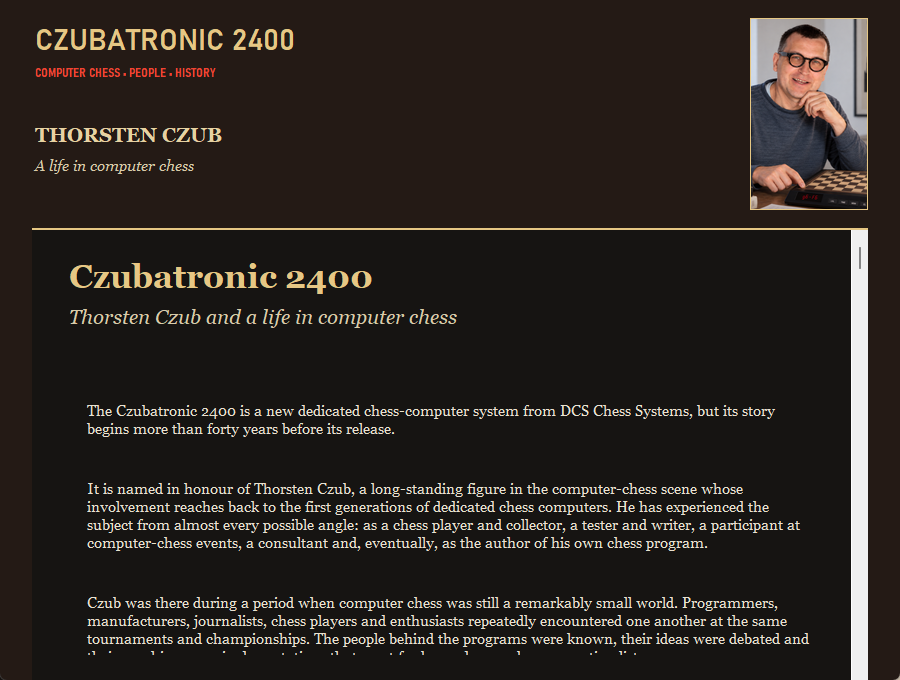
The CZUBATRONIC 2400 is named in honour of Thorsten Czub, whose involvement in computer chess reaches back to the first generations of dedicated machines. He has seen the subject from almost every angle: as a player and collector, a tester and writer, a participant at computer-chess events, a consultant and, eventually, the author of his own chess program.
A black-and-red machine that could not spot an illegal move
It started in a friend’s living room with one of the very first chess computers: a small black-and-red device with an LED display that the two young club players watched spellbound, and then discovered did not check whether their moves were legal. A Chess Champion Delta 1 followed, and an angry letter to Novag about its playing strength that he still has. Then Mephisto II, IIb and III, MM2, Rebel, MM4, MM5, the RISC machines: at one stage around fifteen chess computers, and test reports for a computer magazine.
Cologne 1986
At the World Computer Chess Championship in Cologne, twenty years old, he helped record the games and produce the bulletin, with an Atari but also with paper, scissors, glue and a photocopier, surrounded by Hans Berliner, Helmut Pfleger, Vlastimil Hort, Ed Schröder and Jan Louwman, listening to Thomas Nitsche explain Mephisto III while Richard Lang waited in the wings. Later he sat beside David Levy discussing Chris Whittington’s Chess System Tal, on which he worked as a consultant.
“The programmer mattered. Richard Lang meant something. Dan and Kathe Spracklen meant something. Their programs were not simply interchangeable executables.”Thorsten Czub, from the interview built into the console
Capa
His own program grew alongside the computers he owned: a Sinclair ZX Spectrum with a rubber keyboard, an Amstrad CPC 464 bought in an English supermarket, an Atari ST with a 20 MB hard disk that sounded like Concorde taking off, and finally the PC. He learned from the openly published programs of the time (Sargon, Schrüfer and Kraas, Nimzo, Crafty, Gerbil, TSCP) and named the result after Capablanca, the champion who lost so remarkably few games.
Capa was never meant to be the strongest program in the world. It was a laboratory, and it had character: twelve levels, permanent brain, position setup, and comments of its own that were not always polite (“Since when can humans play chess?”). Then it slept for years.
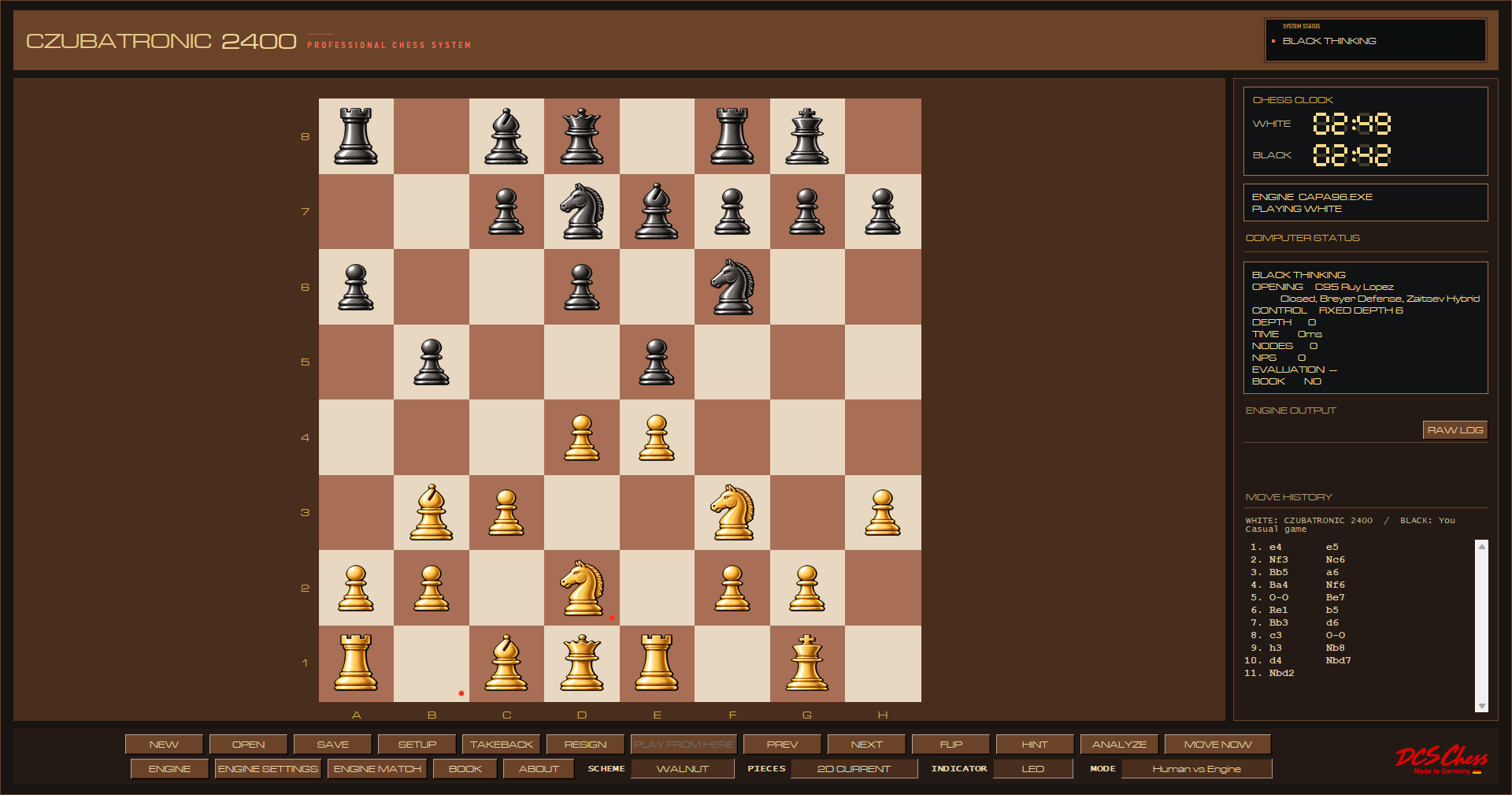
In 2026 development resumed. The PowerBASIC DOS program was moved to FreeBASIC for Windows and given hash tables, an opening book, a UCI interface, modern move ordering, null-move pruning, late-move reductions, game phases and endgame knowledge, without erasing the old Capa. The menu, the twelve levels, the permanent brain and the commentary survive. That is why Capa is the engine inside this machine.
A tribute
The console carries, in its About section, a tribute to the companies and programmers who gave so many players hours of fun and advanced the field:
- Mephisto / Hegener + Glaser
- Fidelity Electronics
- Novag
- SciSys
- Saitek
- TASC
- CXG / Newcrest
- Applied Concepts / Chafitz
- Conchess
- Excalibur Electronics
- RadioShack / Tandy
- Milton Bradley
- Mattel Electronics
- Avalon Hill
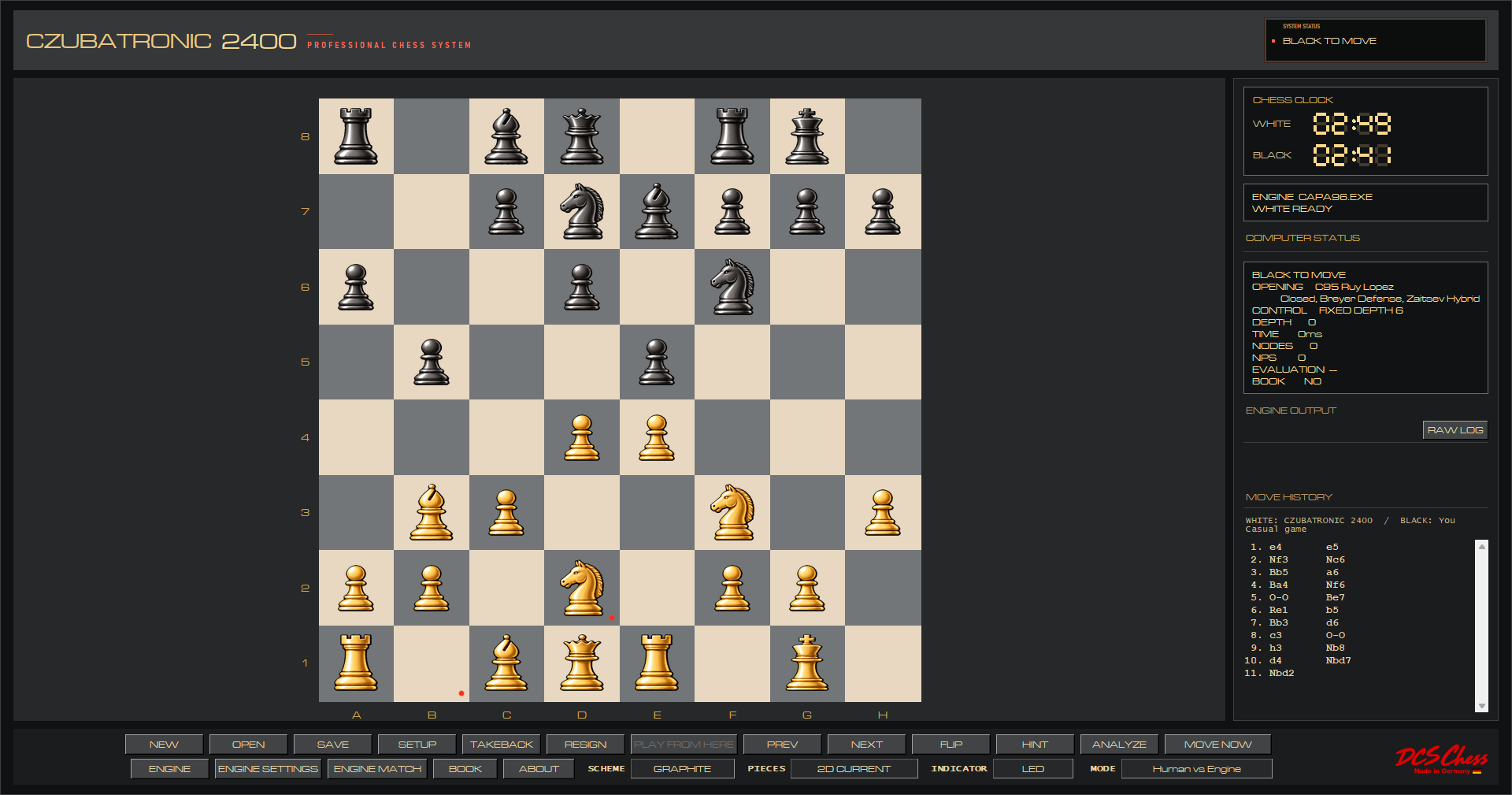
The complete interview and The Story of Capa are built into CZUBATRONIC 2400: open ABOUT in the console.